Negotiations
The room, the paper and the pause
11 August 2026 · 8 min read
Three under-used levers in high-stakes commercial negotiation, drawn from twenty-five years across the table.
The Room, the Paper and the Pause
Three under-used levers in high-stakes commercial negotiation, drawn from twenty-five years across the table.
Negotiation is often described as the art of persuasion.
After more than twenty-five years of negotiating businesses, investments, property, funding arrangements, partnerships and deals where the consequences extended far beyond the numbers on a spreadsheet, I have come to see it differently.
The best negotiators are not necessarily the most persuasive people in the room.
They are often the most observant.
They understand that what is said across a negotiating table represents only part of what is actually happening. The environment matters, the documents matter, thr silence matters, timing matters, and perhaps most importantly, the behaviour of people when they are placed under pressure matters.
Over the years, three particularly powerful levers have repeatedly stood out to me.
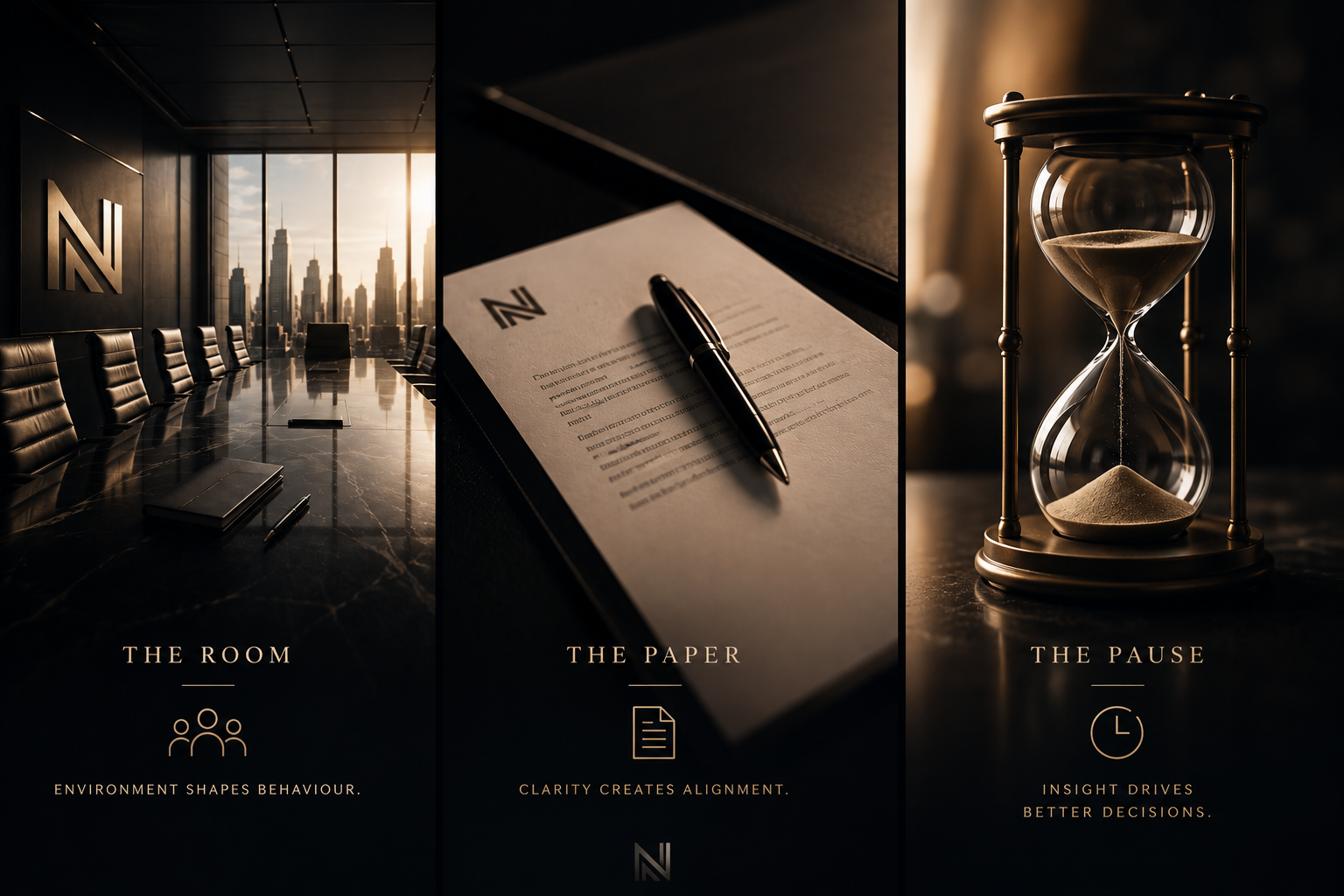
The room. The paper. And the pause.
None is complicated. All three are routinely underestimated.
The Room
Every negotiation begins before the first substantive sentence is spoken. It begins with the room.
Who chose it? Who arrived first? Who is sitting where? Who brought advisers? Who appears comfortable? Who keeps looking towards somebody else before answering a question?
These things can seem trivial when millions of pounds, ownership percentages or contractual obligations are being discussed, but they most definitely are not.
A negotiating room is a temporary ecosystem of authority, confidence, information and dependency.
One of the first things I try to understand is not simply who has the most senior title, but where the real authority sits. They are frequently different things.
The person doing most of the talking may not be the decision-maker. The person saying almost nothing may ultimately determine whether the transaction happens or not.
Watch where people look when an unexpected proposal is made. Watch who takes notes when a particular number is mentioned. Watch who interrupts whom. Watch what happens when the prepared agenda is abandoned.
Formal meetings tell you what people want you to know. Disruption often tells you what you actually need to know.
There is another dimension to the room: atmosphere.
A hostile environment encourages defensive positions. An excessively formal environment can make people reluctant to explore unconventional solutions. A relaxed environment can sometimes produce information that would never emerge across a boardroom table.
That does not mean manufacturing artificial friendliness. It means understanding that environment influences behaviour, and behaviour influences outcomes.
Sometimes changing the room changes the negotiation.
A difficult discussion across a twelve-seat boardroom table can become a very different conversation over coffee with the principal decision-makers.
The commercial facts do not change, the psychology does.
The Paper
The second under-used lever is the paper.
Most people think documents record a deal but in reality, documents frequently shape the deal before it exists.
There is enormous power in being the person who produces the first credible written version of an agreement.
A term sheet, heads of terms, proposal or even a carefully constructed summary email creates something important: an anchor.
Until that moment, the negotiation is fluid.
Everyone has a slightly different interpretation of what has been discussed. Numbers move. Conditions remain ambiguous. People remember conversations differently.
Then somebody puts it on paper.
Suddenly the discussion has a centre of gravity.
People stop negotiating against an empty page and start negotiating against your page.
That distinction matters.
If I write:
Investment: £5 million for 30% equity.
the discussion often becomes:
Is 30% the right number?
rather than:
How should this investment be structured in the first place?
The written proposal has framed the question.
This is why I have always preferred, where appropriate, to put forward a considered structure rather than simply waiting for the other side to define one.
But paper carries another advantage.
It exposes ambiguity.
A verbal agreement can sound remarkably complete until somebody tries to write it down.
Then the gaps appear.
What happens if completion is delayed?
Who controls the bank account?
What constitutes default?
Who appoints the board?
What happens if more capital is required?
Who carries the downside?
How is profit actually defined?
Who can exit, when, and at what valuation?
These are not legal technicalities sitting at the edge of a commercial transaction.
They often are the transaction.
I have seen apparently excellent deals become poor ones because attention was concentrated on headline numbers while the mechanisms underneath them received insufficient scrutiny.
Price attracts attention.
Terms determine outcomes.
And there is a discipline I have learned to apply repeatedly:
If an important commercial understanding cannot survive being written in one clear paragraph, it probably has not been agreed properly.
The Pause
The third lever costs nothing.
And it is perhaps the hardest to master.
Silence.
Most people are uncomfortable with it.
Make an offer in a negotiation and watch what happens.
Someone will usually rush to fill the space.
Sometimes it is the person who has just made the offer.
“We would be prepared to do £4 million…”
Silence.
“…although obviously there might be some flexibility depending on structure.”
A concession has just been made without the other side asking for one.
Why?
Because silence created discomfort.
The instinct was to relieve it.
Experienced negotiators learn not to negotiate against themselves.
If you have made a considered proposal, stop talking.
Allow the other side to process it.
Allow them to respond.
Allow the silence to do some of the work.
The pause has another purpose.
It creates thinking time when emotion begins replacing judgement.
High-stakes negotiations can become intensely personal. Money, reputation, control and ego can all become intertwined.
That is precisely when speed becomes dangerous.
There have been occasions throughout my career when the most commercially valuable thing I have done in a negotiation is say:
“I need to think about that.”
Then leave.
Not as theatre.
Not as a tactic.
Because sometimes you genuinely need distance from the room to see the deal clearly.
A proposal that feels unacceptable at 5:30pm may reveal a workable structure the following morning.
Equally, something that feels irresistible in the excitement of a meeting can look considerably less attractive after twenty-four hours with a spreadsheet and a clear head.
Urgency is occasionally genuine.
But manufactured urgency is one of the oldest tools in negotiation.
“This needs to be agreed today.”
“We have another interested party.”
“The funding disappears on Friday.”
“The board needs an answer tonight.”
Sometimes these statements are entirely legitimate.
Sometimes they are designed to transfer somebody else's timetable onto you.
Knowing the difference matters.
The larger the consequence of a decision, the less willing I am to confuse somebody else's urgency with my own.
Negotiation Is Not Combat
Perhaps the biggest change in my approach over twenty-five years has been my understanding of what a successful negotiation actually looks like.
When I was younger, it was tempting to see negotiation as something to win.
Push harder.
Give away less.
Extract the maximum.
There are transactions where that mentality may produce a short-term advantage.
But many of the most valuable commercial relationships do not end when the contract is signed.
They begin there.
If you negotiate somebody into a position they fundamentally resent, you may have secured excellent terms and created a terrible partnership.
That is not always a victory.
The objective is not necessarily to leave the other side feeling defeated.
The objective is to understand what matters most to them, protect what matters most to you, and discover whether there is a structure in which both sides can move forward with conviction.
That requires something more sophisticated than aggression.
It requires curiosity.
Ask why.
Why is that clause important?
Why does that valuation matter?
Why does completion need to happen by that date?
Why do they want control of that particular decision?
The answer may reveal that the issue you have spent an hour fighting over is not actually the issue at all.
A demand for additional equity may really be about control.
A demand for control may really be about downside protection.
A demand for immediate payment may really be about cash flow.
Solve the underlying concern and entirely different deal structures become possible.
That is when negotiation becomes interesting.
What Twenty-Five Years Teaches You
Experience does not eliminate mistakes.
If anything, business has taught me to be suspicious of anybody who claims to have mastered uncertainty.
Every transaction contains variables you cannot see.
People change.
Markets move.
Funding disappears.
Circumstances intervene.
Information arrives late.
The objective is not to predict everything.
It is to negotiate agreements robust enough to survive when everything does not go according to plan.
And through countless conversations across countless tables, I have learned that some of the strongest negotiating tools are remarkably simple.
Understand the room before trying to control the conversation.
Use the paper to turn assumptions into something that can actually be examined.
And respect the pause enough to know that you do not have to answer every question immediately.
The inexperienced negotiator often believes power comes from speaking.
The experienced negotiator eventually discovers something different.
Sometimes power comes from observing.
Sometimes it comes from writing.
And sometimes it comes from saying absolutely nothing.